
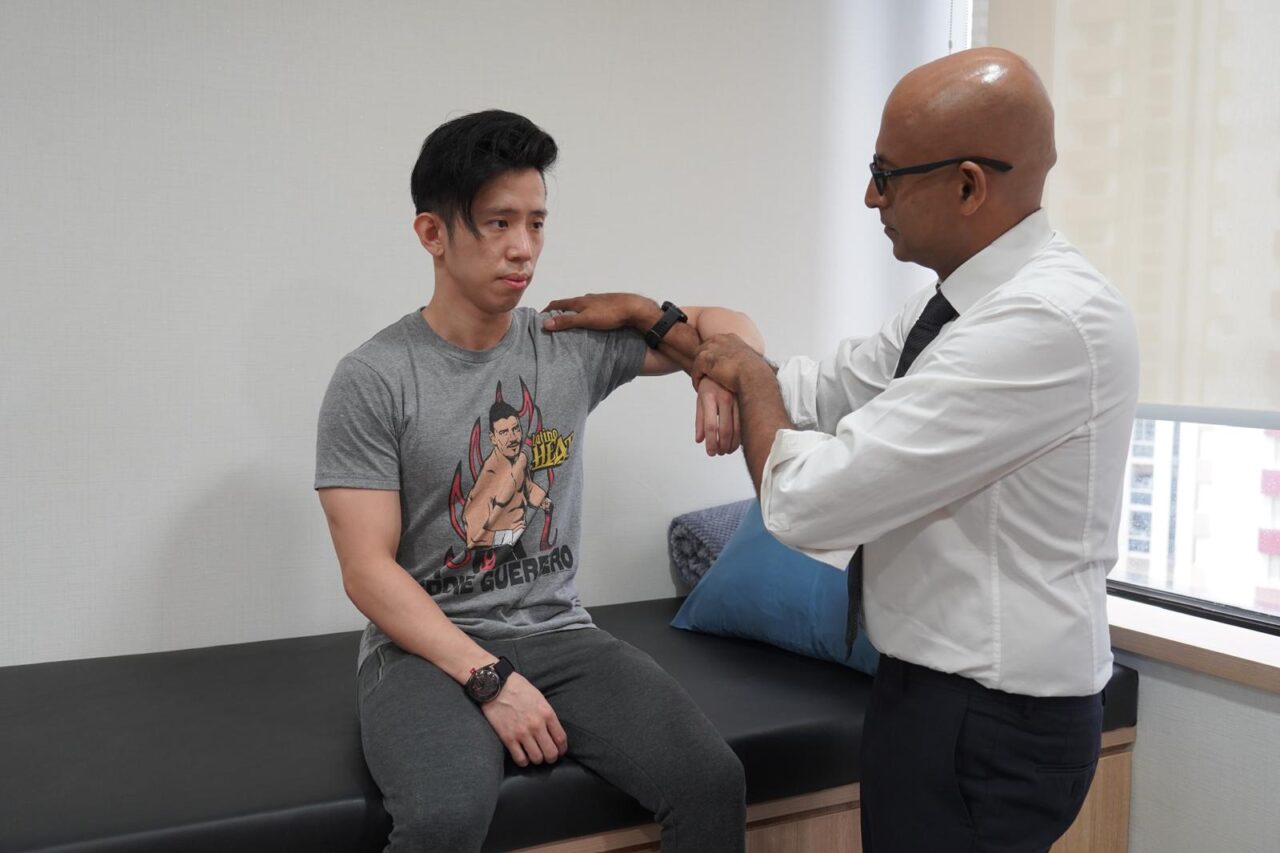
Why Do People Experience Shoulder Pain?
Many adults experience shoulder pain problems that develop gradually from daily activities, sports participation, or natural ageing processes.
The shoulder is the body’s most mobile joint, with an incredible range of motion that comes at the cost of stability. This delicate balance makes it particularly vulnerable to injury and discomfort.

Common shoulder conditions we frequently treat include:
- Rotator cuff injuries: These crucial stabilizing muscles (supraspinatus, infraspinatus, teres minor, and subscapularis) can develop tendinitis from overuse or sustain partial/complete tears from trauma
- Shoulder impingement: Occurs when the rotator cuff tendons get compressed between the humeral head and acromion bone during arm elevation
- Frozen shoulder (adhesive capsulitis): A progressive condition causing severe stiffness and pain due to inflammation and thickening of the joint capsule
- Labral tears: The ring of cartilage (labrum) that stabilizes the shoulder joint can tear from acute trauma or repetitive overhead motions
Whether from sports activities, repetitive occupational movements, or gradual degenerative changes, untreated shoulder pain typically worsens over time and can significantly limit daily function.
What Causes Shoulder Pain?
Detailed Causes of Shoulder Pain
- Traumatic Injuries
- Acute incidents: Falls onto an outstretched arm, direct blows during contact sports, or sudden jerking motions (like in car accidents or tackling in sport) can cause:
- Dislocations (humeral head forced out of socket)
- Fractures of the clavicle or humerus
- Rotator cuff tears
- Labral damage (Bankart or SLAP lesions)
- Recovery challenges: Without proper assessment, treatment or rehabilitation, these injuries often lead to chronic instability, weakness, or post-traumatic arthritis
- Acute incidents: Falls onto an outstretched arm, direct blows during contact sports, or sudden jerking motions (like in car accidents or tackling in sport) can cause:
- Overuse Injuries
- Repetitive overhead activities (swimming, tennis, painting) create cumulative microtrauma
- Common in:
- Throwing athletes (pitchers, quarterbacks)
- Manual workers (construction, electricians)
- Office workers with poor workstation ergonomics
- Age-Related Degeneration
- Natural wear of joint structures over time
- Rotator cuff tendons lose elasticity and vascularity
- Articular cartilage thins, increasing bone-on-bone contact
- Calcium deposits may form in tendons (calcific tendinitis)
- Postural Imbalances
- Rounded shoulders from prolonged sitting create:
- Anterior humeral head migration
- Shortened pectoral muscles
- Overstretched upper back muscles
- This imbalance alters shoulder biomechanics, increasing impingement risk
- Rounded shoulders from prolonged sitting create:
- Nerve-Related Issues
- Cervical radiculopathy (pinched neck nerves) can refer pain to shoulder
- Thoracic outlet syndrome compresses neurovascular structures
- Suprascapular nerve entrapment causes specific muscle weakness
Detailed Symptoms Presentation
Patients typically report:
- Movement-related pain: Sharp discomfort during specific actions like:
- Reaching behind back (fastening bras/seatbelts)
- Lifting objects overhead
- Throwing motions
- Night pain: Often worse when lying on affected side due to:
- Increased joint pressure
- Inflammatory processes peaking at night
- Functional limitations: Difficulty with:
- Personal care (washing hair, dressing)
- Driving (turning steering wheel)
- Sleeping comfortably
- Audible symptoms:
- Clicking/popping from labral tears
- Crepitus (grinding) from arthritic changes
- Weakness: Particularly noticeable with:
- Elevating arms
- Carrying heavy items
- Pushing/pulling motions
How Do You Relieve Shoulder Pain?
Our clinic specializes in evidence-based, personalized shoulder rehabilitation combining multiple therapeutic approaches:
-
Comprehensive Diagnostic Evaluation
- Detailed history: Understanding injury mechanism, aggravating factors, and functional goals
- Physical assessment:
- Range of motion measurements
- Strength testing (manual muscle testing)
- Special tests for specific conditions (Neer’s, Hawkins, Empty Can tests)
- Movement analysis: Identifying compensatory patterns
-
Targeted Treatment Modalities
Manual Therapy Techniques
- Joint mobilizations to restore glenohumeral arthrokinematics
- Soft tissue release for tight pectorals and rotator cuff muscles
- Nerve gliding exercises for radicular symptoms
Therapeutic Exercise Program
- Phase 1 (Acute): Pain modulation strategies, gentle mobility exercises
- Phase 2 (Recovery): Rotator cuff strengthening (beginning with isometrics)
- Phase 3 (Functional): Sport/work-specific drills, plyometrics
Modalities for Pain Relief
- Therapeutic ultrasound for tissue healing
- TENS for pain modulation
- Cryotherapy for acute inflammation
Education & Prevention
- Sleeping position modifications
- Workstation ergonomic adjustments
- Proper lifting mechanics training
"After my rotator cuff treatment, the progressive rehabilitation program got me back to competitive tennis in just 4 months - stronger than before my injury!" - Rachel S., Tennis Coach
Why Our Shoulder Rehabilitation Stands Out
✔ Specialized Expertise: Fellowship-trained in shoulder rehabilitation
✔ Multimodal Approach: Combining manual therapy, exercise science, and pain neuroscience
✔ Progress Tracking: Regular reassessment using validated outcome measures
✔ Prevention Focus: Addressing root causes, not just symptoms
Take Control of Your Shoulder Health
Persistent shoulder problems rarely resolve on their own. Our structured rehabilitation programs help patients:
- Regain pain-free movement
- Restore strength and stability
- Prevent recurrent injuries
- Return to sports and hobbies
Limited consultation slots available – early intervention leads to better outcomes. Book your comprehensive shoulder assessment today.
FAQ: Frequently Asked Questions About Shoulder Pain
-
What is shoulder pain?
Shoulder pain refers to discomfort affecting the shoulder joint, rotator cuff, surrounding muscles, tendons, ligaments, or nearby nerves. Symptoms may vary from mild stiffness to movement-related pain and can affect daily activities.
-
What are common causes of shoulder pain?
Common causes of shoulder pain may include muscle strain, tendon irritation, rotator cuff conditions, joint stiffness, overuse, posture-related stress, or age-related changes. Shoulder pain may also occur following injury or repetitive movements.
-
When should shoulder pain be medically assessed?
A medical assessment may be considered if shoulder pain is persistent, worsening, recurrent, or limiting arm movement, or if symptoms occur after trauma. Evaluation helps clarify possible causes and guide further management.
-
How is shoulder pain evaluated?
Evaluation of shoulder pain usually involves a medical history and physical examination. Where appropriate, imaging such as ultrasound, X-ray, or MRI may be used to support clinical findings.
-
Is shoulder pain always related to sports or injury?
No. Shoulder pain can also be associated with desk work, poor posture, repetitive daily activities, or gradual overuse, even in individuals who are not involved in sports or strenuous exercise.
-
What non-surgical approaches may be discussed for shoulder pain?
Depending on clinical assessment, non-surgical options that may be discussed include activity modification, physiotherapy, rehabilitation exercises, pain management strategies, or image-guided procedures, where clinically appropriate.
-
Can imaging help identify the cause of shoulder pain?
Imaging can help provide additional information about rotator cuff tendons, shoulder joints, bursae, or soft tissues, particularly when symptoms persist or the diagnosis is unclear. Imaging findings are interpreted together with clinical assessment.
-
How is shoulder pain commonly managed over time?
Management of shoulder pain often involves a combination of education, gradual return to activity, posture awareness, physical conditioning, and follow-up review, tailored to individual findings and overall health.
